Your Custom Text Here
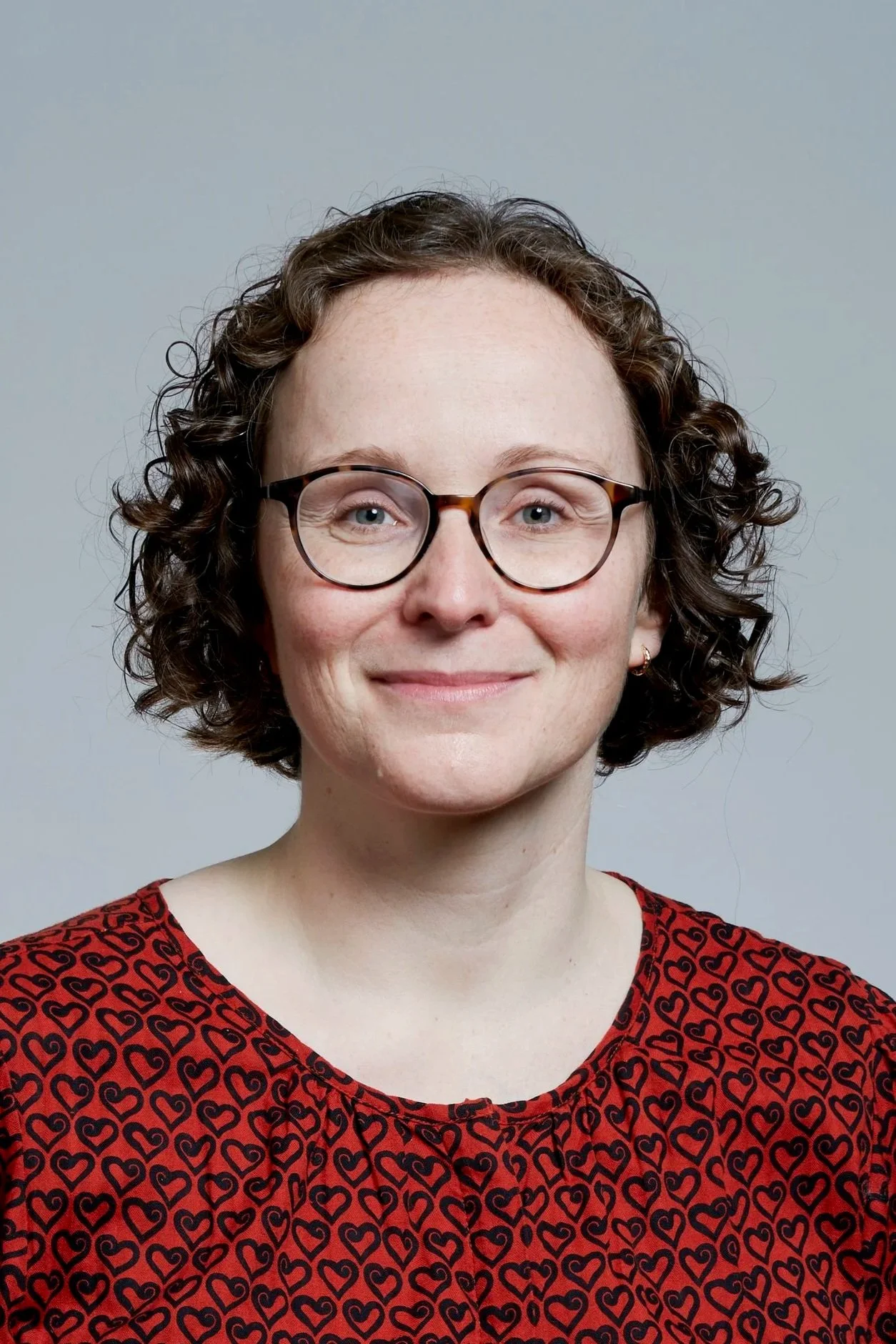
Kim Jelfs completed her PhD in Computational Chemistry at University College London, working on the development and application of modelling to understand zeolite crystal growth and was awarded the Ramsay Medal for the best completing PhD student. She was subsequently a visiting researcher at the Universitat de Barcelona, working with Prof. Stefan Bromley on the prediction of silicate cluster formation, before moving to the University of Liverpool, working as a PDRA across the experimental groups of Profs. Matt Rosseinsky and Andy Cooper. She was focused upon modelling porous materials, with my expertise spanning zeolites, metal-organic frameworks, polymers and porous molecular materials. Several of her computational predictions were experimentally realised. She began at Imperial in 2013 as a Royal Society University Research Fellow (URF) and since 2022 is a Professor of Computational Material Chemistry. Kim was awarded a 2018 Royal Society of Chemistry Harrison-Meldola Memorial Prize, a 2019 Philip Leverhulme Prize in Chemistry and was named the 2022 UK Blavatnik Awards Laureate in Chemistry. Kim holds an ERC Starting Grant and is an Associate Editor for Chemical Communications.
Austin completed her PhD at the University of Oregon in the United States where she focused on developing open source postprocessing software to enhance data analysis of solid-state and molecular calculations and modelling defects in MOFs. Austin is now developing methods for the realization of novel porous liquids. Austin will be an Imperial I-X fellow working in closed loop optimisation for chemical discovery from Oct 2023.
James completed his PhD at University College London in advancing tight-binding methods for rapid calculation of electronically excited states of molecular dimers and organic radicals. He now works as a PDRA in the Jelfs group, funded by the EPSRC programme grant: Digital navigation of chemical space for function, where he is focussed on simulation and screening of the electronic properties of molecular crystalline materials.
Yijie got his Master's degree at University College London. His PhD is to focus on using data-driven methods to model and discover polymer membranes.
Piotr joined the group in 2022 after completing his MChem degree at the University of Edinburgh. He is undertaking a PhD programme with CDT React looking into machine learning driven synthesis of carbon dots and is co-supervised by Prof. Magda Titirici
Gaopeng joined the group in October 2023 with an Imperial President’s Scholarship after completing a Master's degree in Chemical Engineering at Zhejiang University. His PhD focus on leveraging machine learning technique to identify and design novel ionic and porous liquids.
Dat joined the group in 2023, having carried out his MSci at Imperial. He is undertaking a REACT CDT programme on exploring materials for redox flow batteries.
Alex joined the group in 2023 as a PhD student with the REACT CDT, co-supervised by Dr. Rebecca Greenaway and Prof. Mark Crimmin. Previously he had obtained a joint MSc with the National University of Singapore/Technical University of Munich and did his BSc at Russian State University of Oil and Gas. His PhD is focused on a design of a closed-loop catalysts design systems, both computational and experimental.
Joe joined the group in 2024 after completing his MSci degree in Chemistry at Imperial. His PhD research centres around the development of coarse-grained models to be used alongside AI to predict the crystal structures of novel materials.
Tingting joined the group in 2024 after receiving her MSc degree from University College London. Her PhD research focuses on developing computational methods to simulate the solvation effect on the packing of porous organic cages.
Yiduo joined the group in 2025 after receiving her MSc degree from University College London. Her PhD research focuses on discovery of polymer membranes for energy storage and conversion.
Dylan joined the group in September 2025 after completing his MChem degree at the University of Oxford. His research focuses on integrating constraints into generative models. He is co-supervised by Dr. Alex Ganose and Dr. Eleonora Giunchiglia.